also embarked on a very successful education campaign. Kids now know about copyright, and the consequences.I also like the picture from Gizmodo that pretty much explains it all

I've heard the war on drugs is a great success too.
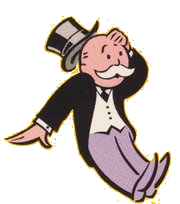 |
Against Monopolydefending the right to innovate |
Monopoly corrupts. Absolute monopoly corrupts absolutely. |
||
|
Copyright Notice: We don't think much of copyright, so you can do what you want with the content on this blog. Of course we are hungry for publicity, so we would be pleased if you avoided plagiarism and gave us credit for what we have written. We encourage you not to impose copyright restrictions on your "derivative" works, but we won't try to stop you. For the legally or statist minded, you can consider yourself subject to a Creative Commons Attribution License. |
|
current posts | more recent posts | earlier posts Mission Accomplished (Hat Tip:
Gizmodo)
USA Today has an article explaining how "unauthorized song swapping" (give them credit for not calling it theft) has been "contained." My favorite part: The RIAA has
also embarked on a very successful education campaign. Kids now know about copyright, and the consequences.I also like the picture from Gizmodo that pretty much explains it all
I've heard the war on drugs is a great success too. [Posted at 06/13/2006 08:40 AM by David K. Levine on IP in the News AllofMp3.com AllofMP3.com is one of those places we never would have heard of if the RIAA wasn't so loudly trying to get it closed down. This follows a long practice by the RIAA of advertising that great stuff is available for free: we learned that you could rip CDs and put them on portable players from their suit against Diamond Rio. We learned about Napster from ... the RIAA. From Slyck News we learn what the RIAA (or its parrot body the IFPI) has to say:
AllofMp3.com is not a legal service either in Russia or anywhere else. It is distributing music without any permission from the artists or copyright holders. Unlike all the legitimate sites, it does not pay artists or copyright holders so it is effectively stealing from those who create music. Like most things that appear to be too good to be true, allofmp3.com is not what it seems. There is not much question that the service isn't legal outside of Russia. But AllofMp3.com is correct in asserting that The site AllOfMP3.com belongs to a Russian company and for 6 years it has operated within the country, in full compliance with all Russian laws. Throughout this period the various government offices have scrutinized site's legality and have not found any breach of the law. So far there has been no decision by any Russian court contesting the site's legality. Sadly there is little doubt that they will soon be shut down as part of the price for Russia joining the WTO. [Posted at 06/06/2006 07:32 PM by David K. Levine on Was Napster Right? Mass Natural From the
NY Times Magazine [because registration is required I will only quote them when they do something dumb] it seems that cheap organic food is a bad thing
To index the price of organic to the price of conventional is to give up, right from the start, on the idea, once enshrined in the organic movement, that food should be priced not high or low but responsibly. As the organic movement has long maintained, cheap industrial food is cheap only because the real costs of producing it are not reflected in the price at the checkout. Rather, those costs are charged to the environment, in the form of soil depletion and pollution (industrial agriculture is now our biggest polluter); to the public purse, in the form of subsidies to conventional commodity farmers; to the public health, in the form of an epidemic of diabetes and obesity that is expected to cost the economy more than $100 billion per year; and to the welfare of the farm- and food-factory workers, not to mention the well-being of the animals we eat. As Wendell Berry once wrote, the motto of our conventional food system at the center of which stands Wal-Mart, the biggest purveyor of cheap food in America should be: Cheap at any price! This type of hatred of Wal-Mart must surely stem from jealousy of their success, not any sort of rational consideration of the great good they have done. Addendum: In the comments Melinda objects that I am too quick to pass over the enviromental issues. She makes some good points. See the comments. [Posted at 06/06/2006 11:26 AM by David K. Levine on Blocking Technology John Updike Tim Sullivan brings to my attention an an article in the NY Times on digital publishing. I was particularly struck by "the novelist John Updike [who] forcefully decried a digital future composed of free downloads of books and the mixing and matching of 'snippets' of text, calling it a 'grisly scenario.'" Taking this at face value (a bad idea - see below) one might wonder what John Updike was thinking: of course every book is made up of snippets. John Updike, after all, simply rearranges the words in the English language to form his books, and I would be surprised if he does not use entire phrases "stolen" from others. For example, a Google Book search for the exact phrase "he turned and ran" turns up 3150 hits - plagiarism, I suppose, and we can only be thankful that such a short phrase cannot be copyrighted.
At this point a disclaimer: the entire Updike talk is available as a (free) podcast, and the NY Times quotation above has little to do with John Updike's actual comments. About half of his talk is a paean to bookstores. He evidentally led a more privileged youth than I, because while I can recall little time spent in bookstores, I recall thousands of happy hours spent in libraries. The last half of his talk is a commentary on a Wired article on the digital revolution in books. His comments read less like a the forceful decrying of a grisly scenario than the sad reflection of a buggy whip manufacturer on the death of his industry. If you want to know what this brave new world is likely to be like, instead of John Updike's poorly informed speculation, you might want to read David Friedman's thoughtful analysis. To be clear - I am doubtful that the "digital revolution" will lead to the end of the sharp "edges" of books as independent entities that we enjoy today. No doubt words, phrases, or even entire paragraphs, will be combined in new ways as new books that have edges of their own. And that is no different than it is today - each book is independent, yet no book is an island independent of the world and literature surrounding it. Indeed, it is the erudition of a man such as Updike that is a great part of his appeal. The NY Times article (although not the actual Updike talk) brought to my mind the issue of the "moral rights" of authors. To what extent is a creator morally entitled to the value created by his creation? There seem to be two camps of "moral rights" those who worship as heroes the great creators (sometimes this is self-worship) and those who worship the free market. As to why great creators of books should be more entitled to fast cars and the other things that money can buy than great cabinet makers I will leave for others to figure out. I simply want to point out that economists celebrate the market because it works and not because it leads to outcomes that are just. I can illustrate this through a simple example having nothing to do with intellectual "property." Let's focus on cabinets. We may imagine that there are six cabinet makers each of whom can produce only one cabinet. The first two can produce a cabinet in an hour, the second two each take two hours, and the other two each take three hours. Each cabinet maker can also spend his hours selling books at the bookstore for $10 per hour. There are six people who want to buy cabinets, one would pay $50 for a cabinet and two would pay $40 and three would pay $10. It is easy enough to see that the actual price of cabinets will be $20 as the two "marginal two-hour" cabinet makers compete with each other to produce the third cabinet. This produces a benefit of $10 to the first two cabinet makers, $30 to the first consumer and $20 to the next two consumers. As it happens the total benefit of $90 is the greatest possible - which is what economists refer to as the "efficiency" of the free market. But is this outcome "just"? Certainly each cabinet maker is recompensed for their time - otherwise they wouldn't produce cabinets. But is the first cabinet maker morally entitled to the extra $10 he gets for his efforts? If the $10 consumers were willing to pay $30, price would rise to $30, and even if the first cabinet maker was selling to the original $50 consumer, he would now net $20 instead of $10. If the "two-hour" cabinet makers could produce cabinets in one hour instead, price would fall to $10 and the first cabinet maker wouldn't get the extra $10 at all. In other words, in the competitive market, the amount you get isn't some measure of your effort or intrinsic worth, but depends on all sorts of idiosyncratic conditions of demand and supply. Economists favor free markets not because they are "fair" or "just" nor are we against them because they are "idiosyncratic and random" but we favor them because they work to produce the greatest good for the greatest many. [Posted at 06/05/2006 11:16 AM by David K. Levine on Was Napster Right? Seattle Glass Artist Sues Over Copyright Infringement The New York Times today reports on a Seattle glass artist,
Dale Chihuly, who is suing two other artists,
one a former colleague, for copyright infringement. He claims they are producing knockoffs
of his sea-inspired shapes and colors; they say that the lip wraps and ripples he designs "have
been around for centuries." Bryan Rubino, his former collaborator says he could be ruined by
the lawsuit, which of course is the point of it. What better way to knock off the competition
than by knocking it off through the courts? It's less messy than using guns, knives, and fisticuffs.
Karrin Klotz, a copyright lawyer and B-school lecturer at the University of Washington, says that Picasso copyrighted a few lines on a pad because of their distinctiveness, but a 2003 US Court of Appeals said, more sensibly, that ideas expressed in nature cannot be copyrighted. Scott Wakefield, Mr. Rubino's lawyer, gives us the money quote: "If the first guy who painted Madonna and Child had tried to copyright it, half of the Louvre would be empty." Where is the libertarian William Kuntsler when we need him? Jim Ostrowski, call your office. [Posted at 06/01/2006 11:39 AM by William Stepp on IP in the News International Roaming So I'm mostly posting this because I can. According to the map on the screen in front of me I'm in between Salt Lake City and Denver at an altitude of 35,000 feet. For the ten and a half hour flight from LA to Munich, I'm paying a lump sum of $27 for a high speed internet connection. So what does this have to do with monopoly? At the moment, using skype, I can call - with pretty good sound - anyone with skype anywhere in the world for free, and anyone in the U.S. or Europe for about 2 cents a minute. Once I arrive in Munich and start using my cell phone, the price goes up to a dollar a minute. There is pretty clearly some lack of competition in international roaming rates - it can't cost fifty times more to call by cell than it does by skype. Fifty times - that is a high price to pay for monopoly.
Addendum: David Laibson was puzzling over the same thing in Munich. The problem is that neither of us can figure out where there is lack of competition. There are multiple US providers that offer overseas roaming, and multiple overseas providers with whom they can and do contract. So unless there is some government regulation here we don't know about, the market looks pretty competitive. My best guess is that what is going on has something to do with bundling - few people are going to switch U.S. providers just because of a small difference in international roaming rates. When T-Mobile offered much better rates than Cingular several years ago, Cingular lowered their rates to be closer to T-Mobile, but they didn't try to undercut them. [Posted at 05/30/2006 06:07 PM by David K. Levine on Against Monopoly Watch google! Robert Cringely has a nice article on pbs.org describing Google's secretiveness and unfair business methods in its advertisement services. A monopolist engaging in monopolistic practices is hardly surprising, and perhaps not worthy of mention even in this site. However I believe Google deserves special attention. Google is slowly but steadily working towards acquiring a dominant position in delivering human knowledge and information. Not only because it is the default search engine for most internet searches, but also because Google is actively storing all sorts of information. Take a look, for example, at its google base project, or at the more famous google library project. Google's chosen motto is "don't be evil", which many interpret to mean "we won't be Microsoft". Indeed, Google distinguishes itself from the software giant because it does thing just right. We all like its products, but this unfortunately increases its dominant position. For these reasons, I believe we should monitor Google's practices very carefully.
[Posted at 05/28/2006 01:27 PM by Andrea Moro on Against Monopoly Immigration One of the most important forms of competition and protections against entrenched monopoly is immigration. Most economists recognize this, and a great many, myself included, signed an open letter arguing in favor of generous immigration policy. Matt Yglesias questions our sincerity.
I'll believe that this is all about altruism when I see an open letter from economists demanding that we scrap the complicated H1B visa system and instead allow unrestricted immigration of foreign college professors without all these requirements about prevailing wages, work conditions, non-displacement, good-faith recruitment of natives, etc. Obviously, there are many foreign born professors in the United States, but there could be many more, wages for academics could be lower, and college tuitions could be significantly lower. If there's really no difference between "us" and "them" economists should be leading the charge to disassemble the system of employment protections they enjoy.I wouldn't argue that our views have to do with altruism. It is possible to selfishly believe that the overall benefits of improving competition outweight the negative impact on yourself. As far as personal self-interest goes - I think that the H1B visa system is pretty ineffective at preventing foreign competition. Yglesias is pretty naive if he thinks that the current system keeps people out. If you look at our economics graduate programs and assistant professors, it isn't clear that it is feasible to increase the percentage who are foreign born - that number can't go over 100%. But regardless the current system is obnoxious and unjust. I would prefer that anyone who wants to come to the U.S. be allowed to do so with minimal paper work. I think there are two views one can have of competition. Mine is - bring it on. [Posted at 05/27/2006 01:03 PM by David K. Levine on Against Monopoly Piracy, piracy everywhere Tim Lee points out that the RIAA would like our lawmakers to cease and desist. The disconnect between the copyright absolutists (and before you ask, no I don't mean Tim, I mean the RIAA) and reality grows greater everyday. [Posted at 05/27/2006 12:46 PM by David K. Levine on Was Napster Right? Stand Up It is being widely reported that two rappers, Ludacris and Kanye are accused of stealing the lyrics to their hit song "Stand Up" from a song by a little known rap group, It's Our Family, called "Straight Like That". The specific accusation seems to be that "Stand Up" repeats many time the phrase "just like that" while the song "Straight Like That" repeats the phrase "straight like that." I guess the accusation is that "It's Our Family" owns the rights to the words "like that" at least if it is repeated enough times. But hey it is their intellectual property, right? Here are the relevant lyrics from "Stand Up"
[Chorus: Ludacris and (Shawna)]and from "Straight Like That" [capone] It's thugged out entertainment niggaThe similarity is obvious. Addendum June 5, 2006: Another triumph for common sense in the courts. "Our Family" lost. [Posted at 05/25/2006 12:20 PM by David K. Levine on Was Napster Right? |
|


Most Recent Comments at 07/29/2026 08:18 AM by Anonymous
at 07/29/2026 08:18 AM by Anonymous
at 07/29/2026 08:18 AM by Anonymous
at 07/29/2026 08:18 AM by Anonymous
at 07/29/2026 08:18 AM by Anonymous
at 07/29/2026 08:18 AM by Anonymous
at 07/29/2026 08:18 AM by Anonymous
at 07/29/2026 08:18 AM by Anonymous
at 07/29/2026 04:57 AM by Anonymous
at 07/29/2026 04:57 AM by Anonymous
at 07/29/2026 04:57 AM by Anonymous
at 07/29/2026 04:57 AM by Anonymous
at 07/29/2026 04:57 AM by Anonymous
at 07/29/2026 04:57 AM by Anonymous
at 07/29/2026 04:57 AM by Anonymous
at 07/29/2026 04:57 AM by Anonymous
at 07/29/2026 03:02 AM by Anonymous
at 07/29/2026 03:02 AM by Anonymous
at 07/29/2026 03:02 AM by Anonymous
at 07/29/2026 03:02 AM by Anonymous
|
