His approach is refreshing. He doesn't oppose copyright but rests his case on the constitution which allows a monopoly limited in time. He argues that in practice there is no limit. Since his appeal to the courts failed to get one, he has chosen the political route, to force legislators to enact one.
Against Monopoly
defending the right to innovate
Monopoly corrupts. Absolute monopoly corrupts absolutely.
Copyright Notice: We don't think much of copyright, so you can do what you want with the content on this blog. Of course we are hungry for publicity, so we would be pleased if you avoided plagiarism and gave us credit for what we have written. We encourage you not to impose copyright restrictions on your "derivative" works, but we won't try to stop you. For the legally or statist minded, you can consider yourself subject to a Creative Commons Attribution License.
current posts | more recent posts | earlier posts
Lessig: the courts won't apply the constitution so politics must
Economist magazine has a great story on Larry Lessig and his attack on copyright extensions link here. Because the article is open, I will not try to summarize it. But the subhead conveys the essence of what Lessig is up to: "Copyrights will not expire so long as Congress is free to be bought to extend them again."
[Posted at 12/08/2007 07:46 PM by John Bennett on Politics and IP  comments(1)]
Will They Never Learn?
The US Congress is working overtime to create new coyright cops while in Canada they busy passing a new DMCA - with such minor considerations as fair use to be considered at some future time by a committee.
[Posted at 12/08/2007 08:53 AM by David K. Levine on Politics and IP comments(0)]
Non-compete Agreements
It isn't widely recognized, but a variety of private contracts have implications similar to government mandated "intellectual property." One of the most significant things is the enforcement by goverment of non-compete clauses. This makes it impossible for employees to leave a firm to work for a rival or start their own firm in competition with their employer. As with most anti-competitive contracts, this is popular with would-be monopolists, but the consequent lack of competition is not especially good for innovation. There is a literature that suggests that Silicon Valley became...well Silicon Valley... and Route 128 in Boston became not much of anything despite Route 128 having the same starting conditions of computer firms and strong universities as Silicon Valley because Massachusetts enforces non-compete agreements, and California will not. If you want to find out more about this the ever valuable Mike Masnick has done a nice job of digging into some of the literature and details.
[Posted at 12/08/2007 08:24 AM by David K. Levine on Blocking Technology comments(6)]
It's Official: The Recording Industry is Run by Idiots
Technical people have always doubted that DRM would work, and always suspected that the recording industry was sold a bill of goods by various techno-charlatans who told computer illiterate CEOs what they wanted to hear. We now have confirmation - the CEO of Universal Music is quoted as saying
I wouldn't be able to recognize a good technology person anyone with a good bullshit story would have gotten past me.
To which we can add the obvious "would and did." You can find more with discussion on Freedom to Tinker.
[Posted at 12/08/2007 08:18 AM by David K. Levine on Was Napster Right? comments(0)]
It takes a lawyer or more to catch one
Jeffrey H. Birnbaum at the Washington Post begins, "Trial lawyers sue each other all the time. Now they are suing each other over what to call themselves." The story goes on link here; the Association of Trial Lawyers of America (ATLA) decided that it was poor PR to keep the distrusted term, trial lawyer, in the title and rechristened themselves as the American Association for Justice (AAJ). Another group of lawyers formed a competing group, the American Trial Lawyers Association (ATLA). AAJ then went to court, arguing the new group's name confused people and violated its trademark on the ATLA acronym. How can you trademark an acronym?
Then a third group, the American College of Trial Lawyers, sued, arguing that the name would confuse people with it. If you are confused as to who has the best case, hire a trial lawyer. It is nice to see them taking each other's money. And making current IP law look ridiculous.
[Posted at 12/05/2007 06:07 AM by John Bennett on IP as a Joke comments(0)]
European ISPs under pressure to attack IP piracy
NYTimes writer ERIC PFANNER reviews the growth of restrictions to protect copyrighted material in several European countries link here. He starts with the involvement of French President Sarkozy.
"Last month Mr. Sarkozy outlined an aggressive proposal to crack down on Internet piracy of music and movies. Under the plan drawn up by a government-commissioned panel, Internet service providers have put aside their objections to cooperating with copyright owners in the fight against illegal file sharing."
"If legislation to enact the plan is approved, the service providers will work with a new, independent authority to identify pirates and warn them to stop. People who ignore the warnings can face suspension, and eventually termination, of their Internet accounts."
"In return for persuading the service providers to crack down, French media owners agreed to remove some of the digital strings they have typically attached to their works. That could allow service providers to enhance their digital music stores and other online content offerings, generating more revenue from them."
Pretty clearly, the ISP's are going to be under growing pressure to fight piracy, including perhaps the use of filters and the monitoring of heavy traffic. France is not alone, as similar pressure has been growing in Britain, Sweden, and Belgium, according the Pfanner.
As far as I can see, there seems to be no disposition to question the whole basis of copyright as inhibiting innovation rather than promoting it. Or to realize that performers and companies can change their business model to prosper without depending on copyright.
[Posted at 12/04/2007 09:44 AM by John Bennett on IP in the News comments(0)]
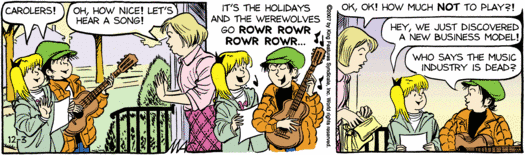
better than selling t-shirts
via John Bennett
[Posted at 12/04/2007 06:52 AM by David K. Levine on Was Napster Right? comments(0)]
Chinese Computer Scientist Jailed for Copyright Infringement
Chen Shoufu, an innovative Chinese computer scientist, was jailed August 16 in Beijing for violating the copyright of China's leading instant-messenging service, Tencent Holdings Ltd., owner of the popular QQ program.
Mr. Chen's program Coral QQ made QQ more user friendly by blocking ads, resolving internet addresses, and identifying the computer from which a message is sent at no charge. (Tencent charges for the ID service.)
He had previously paid a 100,000 yuan fine, about $13,600.
Here is the
article in the Wall Street Journal.
He has become a hero in China, the second largest internet market. One blogger decried Tencent for "bullying Chinese users by monopolizing the market."
This is yet another chilling example in a long list of violations of the liberty of people to use their property in non-invasive and very often innovative ways that ironically could improve the lives of their prosecutors, as well as countless other people.
Historians and analysts of the monopoly formerly known as intellectual property, who are critical of patent and copyright, usually emphasize the drag on innovation caused by these monopolies. Here is another reminder that the assault on liberty and property, rightly understood, is every bit as detrimental to the progress of society.
It's vitally important that critics of intellectual monopoly make this case in their briefs and remonstrations.
[Posted at 11/29/2007 02:41 PM by William Stepp on IP in the News comments(1)]
RIAA told to provide costs in enforcing music piracy
While this story is by no means over, it seems to suggest a bit of blue sky is about to open for those opposing the RIAA demands for rich compensation from those convicted of music piracy. In the case of UMG v. Lindor, the defendant argues that the penalty allowed under the law is excessive, $750 a song, unconstitutionally far exceeds the actual value of what was stolen which she argues is about 70 cents a song. The judge has ordered the plaintiffs to report their actual expenses incurred and they have responded that they can't except at great expense. Eric Bangeman offers a good discussion of the legal issues involved link here.
I suppose that if the per-song penalty is set low enough, the RIAA and its members will not have much of an incentive to sue it would cost too much. But that is probably why the final outcome will depend on the result of appeals.
[Posted at 11/28/2007 09:16 AM by John Bennett on IP in the News comments(0)]
Here's One Small Reason Why Government Should Not Have a Monopoly of the Courts
As reported in the New York Times, a judge in the Niagara Falls, New York, city court, more or less went beserk when a cell phone rang in his court.
After threatening to jail everyone in his presence (except of course the court emloyees) unless the owner of the phone 'fessed up, he impertinently inquired of the defendant in front of him, Reginald Jones, if he knew who owned the phone. When the perplexed Mr. Jones answered that he did not, the judge scuppered his plan to release him, set his bail at $1,500, and ordered him
into custody.
Here is the story.
The judge is going to be removed, so there is some semblance of justice here.
In a free market court system (see David Friedman, The Machinery of Freedom; William Woolridge, Uncle Sam the Monopoly Man; and Murray N. Rothbard, For a New Liberty), the judge would be fired and good luck to him obtaining work as a judge again. And it wouldn't require a government commission to do it--at taxpayer expense, thank you.
[Posted at 11/27/2007 03:52 PM by William Stepp on Against Monopoly comments(0)]


Most Recent Comments
at 05/16/2026 04:40 AM by Anonymous
at 05/16/2026 04:40 AM by Anonymous
at 05/16/2026 04:39 AM by Anonymous
at 05/16/2026 04:39 AM by Anonymous
at 05/16/2026 04:39 AM by Anonymous
at 05/16/2026 04:38 AM by Anonymous
at 05/16/2026 04:38 AM by Anonymous
at 05/16/2026 04:37 AM by Anonymous
at 05/16/2026 04:37 AM by Anonymous
at 05/16/2026 04:37 AM by Anonymous
at 05/16/2026 04:37 AM by Anonymous
at 05/16/2026 04:34 AM by Anonymous
at 05/16/2026 04:34 AM by Anonymous
at 05/16/2026 04:34 AM by Anonymous
Dr. Who? 555
at 05/16/2026 04:34 AM by Anonymous
at 05/16/2026 04:34 AM by Anonymous
Dr. Who? 555
at 05/16/2026 04:34 AM by Anonymous
Dr. Who? 555
at 05/16/2026 04:34 AM by Anonymous
Dr. Who? 555
at 05/16/2026 04:34 AM by Anonymous
at 05/16/2026 04:32 AM by Anonymous