
The series continues at the Wateringhole
 |
Against Monopolydefending the right to innovate |
Monopoly corrupts. Absolute monopoly corrupts absolutely. |
||
|
Copyright Notice: We don't think much of copyright, so you can do what you want with the content on this blog. Of course we are hungry for publicity, so we would be pleased if you avoided plagiarism and gave us credit for what we have written. We encourage you not to impose copyright restrictions on your "derivative" works, but we won't try to stop you. For the legally or statist minded, you can consider yourself subject to a Creative Commons Attribution License. |
|
current posts | more recent posts | earlier posts The Patent Trolls
The series continues at the Wateringhole [Posted at 01/02/2008 09:51 AM by John Bennett on IP in the News Congress and the DMCA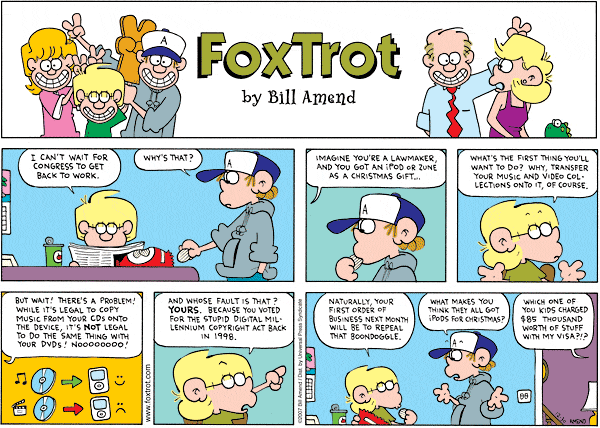 [Posted at 12/31/2007 02:14 PM by John Bennet on IP in the News University of Oregon v. RIAA Adam Liptak has an interesting Sidebar in today's NYT about the Attorney General of Oregon defending the University of Oregon's decision to fight an RIAA subpoena seeking the identities of students the RIAA suspects of sharing music. The University and Attorney General are saying that privacy protection for the University's students is more important than complying with the RIAA subpoena, particularly since this RIAA legal operation more resembles an extortionary shakedown in which violators of copyright are given the opportunity to settle (typically to the tune of three or four thousand dollars) rather than using actual judicial proceedings to determine the approriate compensations. [Posted at 12/31/2007 08:55 AM by Stephen Spear on IP in the News Man stands up to the RIAA with what looks like a winning case Writing in the Washington Post today, Marc Fisher observes, "Despite more than 20,000 lawsuits filed against music fans in the years since they started finding free tunes online rather than buying CDs from record companies, the recording industry has utterly failed to halt the decline of the record album or the rise of digital music sharing link here.
"Still, hardly a month goes by without a news release from the industry's lobby, the Recording Industry Association of America, touting a new wave of letters to college students and others demanding a settlement payment and threatening a legal battle." He then goes to describe the case of "Jeffrey Howell, a Scottsdale, Ariz., man who kept a collection of about 2,000 music recordings on his personal computer, the industry maintains that it is illegal for someone who has legally purchased a CD to transfer that music into his computer." Howell is fighting the case. The problem here is that plenty of legal precedent exists that what Howell did is within his fair use rights. Once again, the RIAA is trying to extend the reach of copyright, at which it has so far been very successful. But Fisher concludes by noting that the "RIAA's legal crusade against its customers is a classic example of an old media company clinging to a business model that has collapsed." Know hope! [Posted at 12/30/2007 02:30 PM by John Bennett on IP in the News Pimps and Ferrets: Copyright and Culture in the United States, 1831-1891 History is supposedly written by the victors, so there has been very little written on the cultural (as opposed to the legal) history of copyright in the U.S. during the 19th century. Now Eric Anderson has gone a long way toward redressing this imbalance with his superb PhD dissertaion, available online,
Pimps and Ferrets: Copyright and Culture in the United States, 1831-1891 , which can be found at
questioncopyright.org .
Here is the 1.83 MB Pdf file . This study fills a yawning gap in copyright history, and offers a radically different focus on the development of this institution from the dominant legal perspective. The bookends are the Copyright Act of 1831, and the International Copyright Act of 1891, but there is a good summary of early American copyright history and its British background. The controversies, schools of thought, and heroes and villains are well portrayed in this thoroughly researched work. The growing scope, duration, and, especially, complexity of copyright law are highlighted. (No prize for guessing which profession hit the jackpot.) Important legal cases and legislative battles are discussed. But the most interesting part of the book might be the absorbing discussion of the magazine and newspaper debates over copyright, ranging from the Southern Literary Messenger (which he notes is now online) to the Chicago Daily Tribune (which published dozens of articles opposing international copyright) to Benjamin R. Tucker's magazine Liberty (alas mentioned only in a footnote, which surely undervalues the influence of its decade-long debate--and Lysander Spooner is not mentioned at all, but the obscure John Blair Dabney is, rightly, considering the strength of his argument). If you've ever wondered why the American Copyright Club had such little influence, the answer is here. Like most historians of this subject, he discusses Charles Dickens' American campaign for international copyright, but neglects to mention that Dickens was actually paid royalties by three American publishers, if not by the ones that printed unauthorized editions. Although he doesn't focus on the economics of copyright, he does discuss the economic impact of protection, the effect of rent-seeking, and the prices of copyrighted and uncopyrighted books in both England and America. "Cheap books" was the battle cry in America and rightly so. In an illuminating passage, he notes "that many academic approaches ... miss how copyright is -- in practice and in ideology -- a mechanism for regulating the market." He points out that this leads to a misunderstanding of the development of copyright and overemphasizes "romanticized authorial propaganda for causal agents of change." This is only one of several historiographical myths he punctures. The bibliography is excellent, although articles by libertarian writers N. Stephan Kinsella, Roderick Long, and Tom G. Palmer are listed even though they are not cited or discussed in the text or footnotes. Why this is so I have no idea. Maybe someone who knows the ins and outs of academic publishing better than I do can explain this. As for the meaning of "Pimps and Ferrets," you'll have to read it to find out. I haven't read anything as interesting in a while. [Posted at 12/27/2007 04:04 PM by William Stepp on IP History Confirmation that the young don't think much of copyright David Pogue posts responses to his earlier post on the results of his survey of the responses of the young to copyright protection link here and here. The comments again make the point that the young think they don't need to obey copyright restrictions, particularly since they are so complex that most people can't figure out when they are violating them. They also understand that the artists can make money by other means that CDs, like live performances, and that the prices charged by the record companies are grossly high. [Posted at 12/27/2007 02:00 PM by John Bennett on Against Monopoly The Length of Copyright Christian Zimmermann had spent a busy Christmas finding material for us. In a breathtaking extension of copyright from 70 to 3000 years, Egypt is copyrighting the pyramid. Sounds like a hoax, but apparently not. Why U.S. companies think that they are going to live by the sword has never been obvious to me - the U.S. is johnny-come-lately to the invention business. Suppose England decides to retroactively extend patents to cover the industrial revolution, and demands license fees on every invention that has used an idea from that period? Or the Saudis retroactively copyright the arabic numerals?
On this cheerful note, an oldie but goodie, also from Christian, the Johnson and Johnson lawsuit against the Red Cross - for using the Red Cross... [Posted at 12/26/2007 09:09 AM by David K. Levine on Was Napster Right? RIAA: If it is too good, it is pirated Brad DeLong posted this today and it is fitting link here:
(Ooops--it seems to have disappeared, but I copied and put the URL and time of day when it was posted at the end, so it must have been there) Perhaps the Best Argument for the Destruction of the Music Companies Ever Made DymaxionWorldJohn Cogitamus: The Music Industry's talking points: "Hey, we're obsolete.": via Matt, the RIAA gives consumers holiday advice: Watch for Compilations that are "Too Good to Be True": Many pirates make "dream compilation" CDs, comprised of songs by numerous artists on different record labels who would not likely appear on the same legitimate album together. So, if you see an album with all of your favourite artists on it, performing the songs you love, for the love of God don't buy it -- it's probably pirated! , this is their press release. And in it, they explicitly state that pirates are putting together products that people want more than the legitimate variety. This, of course, is why teenagers should be sued in to penury, rather than something as revolutionary as the music industry putting together its own compilations that people want to buy. Source: Grasping Reality with Both Hands: Economist Brad DeLong's Semi-Daily Journal Address : http://delong.typepad.com/ Date Visited: Tue Dec 25 2007 12:09:56 GMT-0500 (Eastern Standard Time)
[Posted at 12/25/2007 10:04 AM by John Bennett on Against Monopoly Sonny Bono Was a Piker One of the main arguments put forth by the copyright reformist camp is that the term of copyright has gradually been lengthened until now it's as long as life of the author plus 70 years. Incentives all the way to the grave and beyond, if you will; but this doesn't bode well for innovation and is increasingly problematic with more legal wrangling and wasteful rent seeking.
IP advocates like to analogize IP to physical property insofar as they can, while noting obvious differences too. See, for example, Frank Easterbrook's essay "Intellectual Property Is Still Property." (No link available, but it's reprinted in Adam D. Moore, ed., Information Ethics .) Physical property, as everyone grants, has no term limit, unlike IP. Physical property also never enters the public domain, although it can be abandoned, and then re-homesteaded by a new owner. IP does enter the public domain though, after the expiration of a copyright (or patent). Lysander Spooner , a 19th-century opponent of slavery and, eventually, of the U.S. Constitution, thought this was bizarre. In his uncompleted 1855 tract The Law of Intellectual Property , he argued for a perpetual right of property in ideas, and stated that it: "is intrinsically the same as, and stands on identically the same grounds with, his right of property in material things; that no distinction, of principle , exists between the two cases" (p. 30). (Spooner's italics.) So here's my challenge to lawyers such as Frank Easterbrook, Lawrence Lessig, and William Patry: if you really believe that IP is property and that IP holders' rights should be protected just as their rights in their material property are, why not overturn Sonny Bono and extend copyrights (and patents) indefinitely, as long as the underlying IP has not been abandoned by its owner(s)? So why stop a mere 70 years after an author's demise? Presumably this would also put an end to rent seeking and endless lawsuits. Failure to do so strikes me as prima facie evidence (to quote my old monetary theory prof. in another context) that IP is not property, and in fact is just an old fashioned monopoly. In other words it's the monopoly formerly known as intellectual property. And where there's a monopoly, there's bound to be a gaggle of lawyers chasing from behind. [Posted at 12/22/2007 08:30 PM by William Stepp on IP History The WTO, Gambling, and Intellectual Property The United States Puritanical values collided with its neoliberal ideology in passing a law that prevented online gambling. Several companies -- Microsoft, Google, Yahoo -- just paid fined for posting ads for Internet gambling. Antigua and Barbuda protested since the US allows other forms of domestic gambling. They demanded huge compensation for their loss of business. The WTO judgment offers a much smaller amount, but it gives the country the right to violate intellectual property up to $21 million.
Kanter, James and Gary Rivlin. 2007. "In Trade Ruling, Antigua Wins a Right to Piracy." New York Times (22 December). link here "Antigua and Barbuda won compensation from the United States on Friday in a long-running trade dispute about gambling, but the amount was far lower than the tiny Caribbean nation had been seeking. A World Trade Organization (WTO) arbitration panel granted Antigua's request to levy trade sanctions on U.S. intellectual property, for instance by lifting copyright on films and music to sell it themselves, prompting concern from Washington." "The WTO panel said Antigua was entitled to compensation of $21 million a year from the United States for being shut out of the U.S. online gambling market. The ruling is only partial consolation for the former British colony, which built up an Internet gambling industry to replace declining tourism revenues, only to find itself shut out of the world's biggest gambling market." "The award falls far short of what Antigua had demanded -- $3.44 billion in "cross-retaliation," allowing it to seek damages outside the original services sector. Washington had argued Antigua was entitled to only $500,000 in compensation." [Posted at 12/21/2007 06:41 PM by Michael Perelman on Intellectual Property |
|


Most Recent Comments at 05/16/2026 04:40 AM by Anonymous
at 05/16/2026 04:40 AM by Anonymous
at 05/16/2026 04:39 AM by Anonymous
at 05/16/2026 04:39 AM by Anonymous
at 05/16/2026 04:39 AM by Anonymous
at 05/16/2026 04:38 AM by Anonymous
at 05/16/2026 04:38 AM by Anonymous
at 05/16/2026 04:37 AM by Anonymous
at 05/16/2026 04:37 AM by Anonymous
at 05/16/2026 04:37 AM by Anonymous
at 05/16/2026 04:37 AM by Anonymous
at 05/16/2026 04:34 AM by Anonymous
at 05/16/2026 04:34 AM by Anonymous
at 05/16/2026 04:34 AM by Anonymous
Dr. Who? 555 at 05/16/2026 04:34 AM by Anonymous
at 05/16/2026 04:34 AM by Anonymous
Dr. Who? 555 at 05/16/2026 04:34 AM by Anonymous
Dr. Who? 555 at 05/16/2026 04:34 AM by Anonymous
Dr. Who? 555 at 05/16/2026 04:34 AM by Anonymous
at 05/16/2026 04:32 AM by Anonymous
|
