The page says the text may be copied and used consistent with their permissions. I'm guessing they won't be quoting anything from these precincts on copyright.
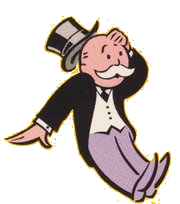 |
Against Monopolydefending the right to innovate |
Monopoly corrupts. Absolute monopoly corrupts absolutely. |
||
|
Copyright Notice: We don't think much of copyright, so you can do what you want with the content on this blog. Of course we are hungry for publicity, so we would be pleased if you avoided plagiarism and gave us credit for what we have written. We encourage you not to impose copyright restrictions on your "derivative" works, but we won't try to stop you. For the legally or statist minded, you can consider yourself subject to a Creative Commons Attribution License. |
|
current posts | more recent posts | earlier posts Do You Need Permission to Quote Yourself? I just stumbled on this
quote
from an
essay
I wrote a few years ago. The quote is the sum total of my contribution to libertarian thought.
The page says the text may be copied and used consistent with their permissions. I'm guessing they won't be quoting anything from these precincts on copyright.
[Posted at 03/04/2008 06:28 PM by William Stepp on IP as a Joke Penguin, others are phasing out DRM DigitalKoans reports that Penguin is dropping DRM. It also links to a New York Times article that shows this is a general trend. Good news. [Posted at 03/04/2008 04:33 PM by Christian Zimmermann on DRM What is Amoxicillin What is amoxicillin used for?
Amoxicillin is an antibiotic of the penicillin family. It is bactericidal, that is, it destroys microbes. It is therefore used to treat a large number of infections caused by germs sensitive to this antibiotic. Among the most frequent infections that can be treated with amoxicillin are some tonsillitis, acute otitis media, sinusitis, pneumonias, urine infections, skin infections and dental infections. It is also used in combination with other drugs in the treatment to eradicate Helicobacter pylori from the stomach. Why is it often accompanied by clavulanic acid? Bacteria, being in frequent contact with antibiotics, create mechanisms to defend themselves against them, this is what we know as resistance. There are different types of resistance mechanisms. Some microbes are capable of producing enzymes called beta-lactamases that render amoxicillin ineffective. When we physicians suspect that some of these infections may be caused by this type of germs, we add clavulanic acid to the amoxicillin prescription, which inactivates these beta-lactamases so that amoxicillin becomes effective again. If clavulanic acid is added to amoxicillin to treat infections caused by other microbes that do not produce beta-lactamases, it does not improve the action of amoxicillin and, on the contrary, causes an increase in side effects such as fungal infections in the mouth or vagina. What mistakes do we most frequently make when taking amoxicillin? The most frequent mistakes are taking amoxicillin for fewer days than indicated by the doctor, generally because "you are already feeling well", and taking it with an interval of hours between doses different from that prescribed by the doctor. The most common interval is every 8 hours. Even if it is 3 times a day, it is difficult to comply with the interval if the intake coincides with breakfast, lunch and dinner. Another common mistake is to take it with a "stomach protector" such as omeprazole, since it is not necessary. When and how should it be taken? Your doctor will indicate an interval of hours between each dose and for a certain number of days. Take it like this. With amoxicillin, the most frequent interval is every 8 hours, but in some cases your doctor may tell you to take it every 12 hours. The duration is different according to the type of infection, and although there is a tendency for the number of days required to be less and less, it is important that you never shorten it on your own. Translated with www.DeepL.com/Translator (free version) [Posted at 03/03/2008 06:18 PM by William Stepp on IP History Trademark Pwnage Trademork.com is an excellent source of silly trademarks, as shown by this recent example: A Finnish computer game company is applying for a trademark for the term "pwnage," a recently coined word signifying that someone has been had. The company cannot lay any claims that it created the word, and the word is now commonly used in the gaming and online communities.
I want to trademark "trademark"... [Posted at 03/03/2008 03:57 PM by Christian Zimmermann on IP as a Joke Scientology vs. the freedom of information The L.A. Times turns a spotlight on the Church of Scientology's abuse of IP claims in order to try and silence its critics.
No corner of the Web, it appears, is safe for Scientology. Blogger and lawyer Scott Pilutik recently posted a story noting that Scientology was yanking down EBay auctions for used e-meters, the device the church uses for spiritual counseling. EBay allows brand owners -- Louis Vuitton or Rolex, say -- to remove items they believe infringe on their trademark or patent rights. Basically, fakes. But, Pilutik said, the used e-meters being taken down were genuine. Reselling them was no different than putting a for-sale sign on your old Chevy. Read the whole article. [Posted at 03/03/2008 03:47 PM by Justin Levine on IP as Censorship When copyright forces copying against your will Back when libraries only had printed material, they could lend books under the first sale doctrine: once they had purchased a legally copyrighted work, they could sell or dispose of it as the see fit. Things have changed a bit with the advent of online content. To prevent libraries from giving away PDFs, publishers are now licensing on-line content, which is different from selling: use is limited to library premises, usually extended to a campus.
This raises issues with inter-library loans (ILL). No problems with hard copies, which are lent physically and returned. With online content, licenses do not allow to simply forward a PDF file. As Elsevier makes explicit in its policy, the requested item needs to be printed, then scanned before being send through Ariel (an electronic ILL network most libraries use). Thus, copyright rules lead to more paper being wasted because content is online. Great for efficiency and the environment. Hat tips: Peter Suber and DigitalKoans. [Posted at 03/02/2008 07:59 PM by Christian Zimmermann on Fair Use A Trademark Brouhaha Citizens United, a Washington District of Crime outfit, sent a
"cease-and-desist" letter
to Citizens United Not Timid trying to intimidate it and to get it to stop using Citizens United in its name. Its letter contains a not-so-vailed threat of legal action.
Michael D. Becker, the lawyer for Citizens United Not Timid, responded with this cutting-edge analysis of their complaint. Mr. Becker would no doubt disavow this, but the letter speaks not only for itself, but for all victims of trade mark bullies. These links can be found at its website. David Rosen mentions the group in this article. Thanks to Mark Brady for the scoop and the links.
[Posted at 03/02/2008 05:20 AM by William Stepp on Against IM "Buy it Now" via Christian Zimmermann...ebay pays cold cash to be able to put a hot button called "Buy it Now" on its auctions link here [Posted at 03/01/2008 02:54 PM by David K. Levine on IP Law Patents (the one horse shay) are coming apart The GAO reports some impressive numbers on the USPTO link here and here and here. The latter plans to hire 1200 examiners a year for the next five years, but the backlog will increase to more than 1.3 million applications. If it could hire 2000 a year (presumably, it can't), the backlog would only increase by 260,000 to 953,643. So they are going to get the Patent Reform Act to slow the growth of the backlog.
Just thinking out loud, how can that be done? Any changes in patent law will almost certainly have to cover patents already granted. So depending on how they change the law, they may actually increase the backlog and/or the amount of litigation. Talk about a broken system. [Posted at 02/28/2008 07:20 PM by John Bennett on Patents (General) Movies and the web: piracy will drive the market In two articles the Economist calls a leader here and a briefing here, it gives a long account of the state of the movie industry and its attempts to prevent the erosion of income from piracy, while preserving its income streams from DVDs and the big retailers like WalMart. It makes a recommendation that the industry should turn to the internet, which it is failing to exploit fully, exploiting grudgingly, or actually resisting.
While the web technology isn't fully developed, it will no doubt come, if not by plan, by the pirates. Though the Economist doesn't recognize it, piracy is powerfully encouraged by the fact that the marginal costs of an additional sale are vanishingly small while the companies insist on keeping their prices high. The difference is just way too high to maintain.
[Posted at 02/27/2008 07:56 AM by John Bennett on The IP Wars |
|


Most Recent Comments at 05/16/2026 04:40 AM by Anonymous
at 05/16/2026 04:40 AM by Anonymous
at 05/16/2026 04:39 AM by Anonymous
at 05/16/2026 04:39 AM by Anonymous
at 05/16/2026 04:39 AM by Anonymous
at 05/16/2026 04:38 AM by Anonymous
at 05/16/2026 04:38 AM by Anonymous
at 05/16/2026 04:37 AM by Anonymous
at 05/16/2026 04:37 AM by Anonymous
at 05/16/2026 04:37 AM by Anonymous
at 05/16/2026 04:37 AM by Anonymous
at 05/16/2026 04:34 AM by Anonymous
at 05/16/2026 04:34 AM by Anonymous
at 05/16/2026 04:34 AM by Anonymous
Dr. Who? 555 at 05/16/2026 04:34 AM by Anonymous
at 05/16/2026 04:34 AM by Anonymous
Dr. Who? 555 at 05/16/2026 04:34 AM by Anonymous
Dr. Who? 555 at 05/16/2026 04:34 AM by Anonymous
Dr. Who? 555 at 05/16/2026 04:34 AM by Anonymous
at 05/16/2026 04:32 AM by Anonymous
|
