Against Monopoly
defending the right to innovate
Monopoly corrupts. Absolute monopoly corrupts absolutely.
Copyright Notice: We don't think much of copyright, so you can do what you want with the content on this blog. Of course we are hungry for publicity, so we would be pleased if you avoided plagiarism and gave us credit for what we have written. We encourage you not to impose copyright restrictions on your "derivative" works, but we won't try to stop you. For the legally or statist minded, you can consider yourself subject to a Creative Commons Attribution License.
current posts | more recent posts | earlier posts
IP has got to go
Techdirt link here and Slashdot here both offer an hour video of a lecture on IP that is stimulating and well worth watching, particularly for someone like me who is a newcomer to these issues. If you haven't seen it, you have missed a good show and a compelling argument. The lecturer, patent attorney Stephan Kinsella, bills himself as a libertarian but he makes a strong utilitarian argument as well that all the evidence shows that the ostensible gains are exceeded by the costs of the system and that society is clearly poorer as a result. To me the utilitarian argument seems to be the one most likely to succeed with the general public, i.e., that IP is bad for the average person.
[Posted at 05/12/2008 09:42 AM by John Bennett on Intellectual Property  comments(0)]
Bank of America tries to patent comparative country studies
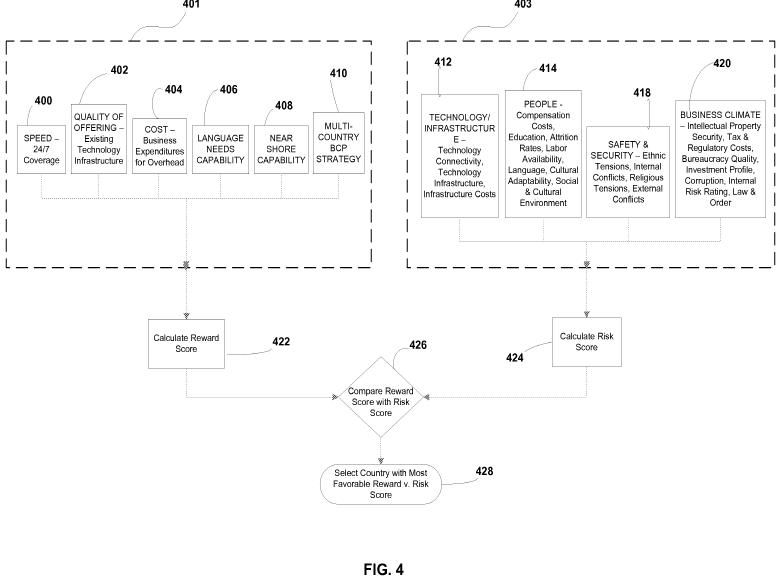
The Bank of America has come up with another "gee-whiz innovation" that will come as a surprise to almost nobody. It proposes to carry out comparative country studies to determine whether a company should move its operations abroad and if so, where. And it is applying for a patent on the process link here.
The problem here is that prior art is rampant in this proposal. Companies have been doing exactly such studies on their own forever. The graphic that is included in the application is a catalog of the obvious
 .
.
One must wonder too, about the public relations wisdom of including this quote in the application: "A typical American employee,' complains BofA, 'demands a high salary, good benefits, a good work environment, vacation time, and other job-related perks.' Such problems are solved with BofA's patent-pending methodology, which eliminates 'demanding work force' problems by identifying another country for a corporation to relocate its work force to."
[Posted at 05/11/2008 07:35 PM by John Bennett on IP as a Joke comments(1)]
China's IP protection coming--unfortunately
Writing on his website, James Fallows points a finger at CCTV, China's state television network, for running a story warning against pirated or unauthorized copying of its coverage of the Beijing Olympics as violating the "intellectual property rights of CCTV, the official broadcaster" link here.
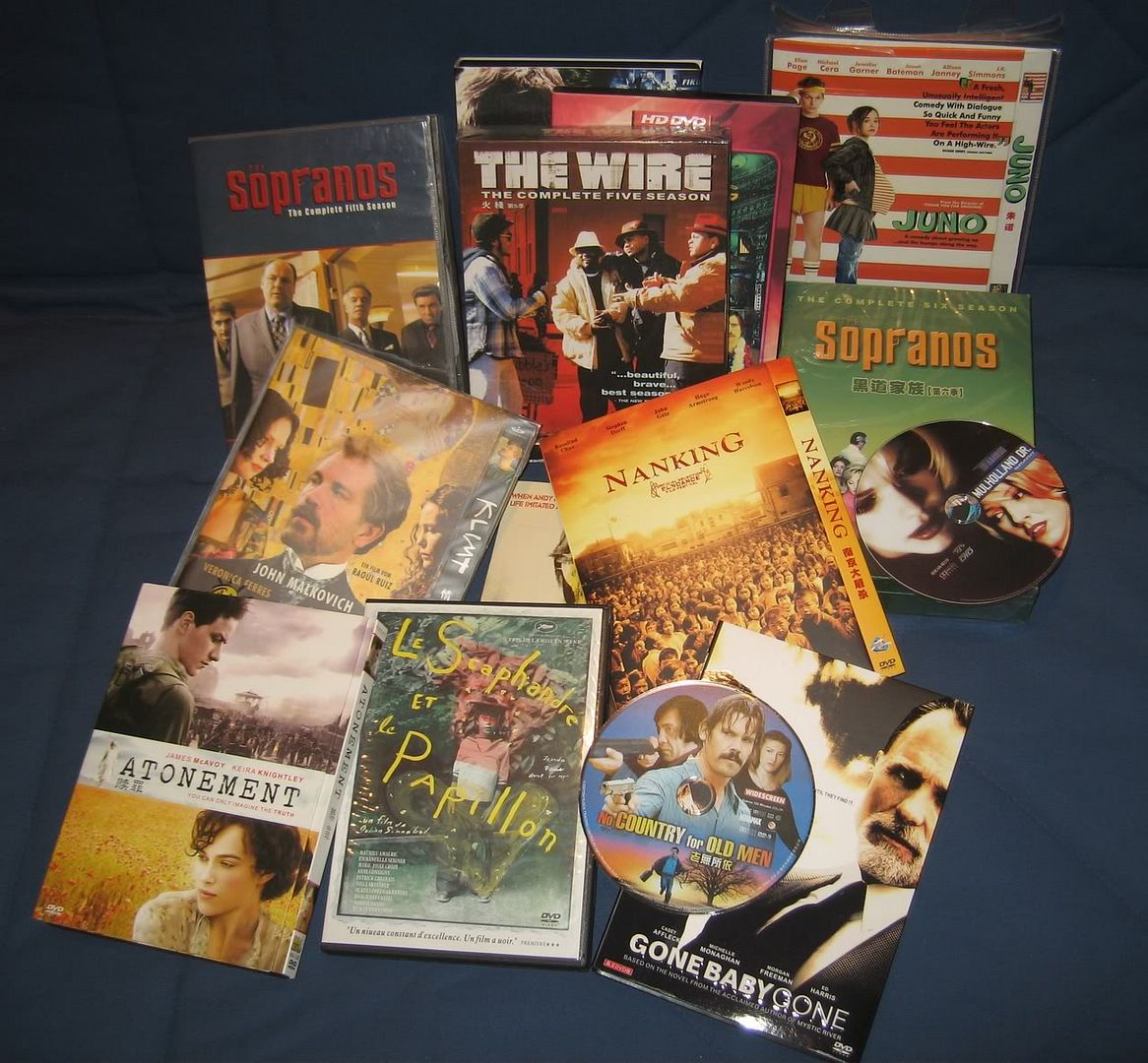
Fallows sniggers, "I can barely imagine the horror of some group in China copying someone else's proprietary material and distributing it outside the proper channels." And then shows a graphic of what is available at his local video store.
This reminds me once again that developing countries are unlikely to enforce IP rights until they have a vested interest in protecting them when they themselves develop substantial income producing rights. Given the speed with which China is developing, the days of cheap pirated copies have got to be numbered. Too bad.
[Posted at 05/08/2008 08:59 AM by John Bennett on IP in the News comments(0)]
Laws are copyrighted?
From Boing Boing: Oregon considers that its laws are copyrighted, thus you cannot reproduce them. The problem stems here from websites that reproduce Oregon laws in full. It may make some sense to make sure that there is only one version of laws out, so as to avoid confusion. The Oregon State Government website, however, has apparently half a million HTML errors and does not satisfy criteria for accessibility. Thus, non-profit, independent operators jumped in.
Oregon holds that illicit replication would impact its own sales of laws. In other words, Oregon wants a monopoly, and it is apparently already providing the good quality that comes with it.
[Posted at 05/07/2008 03:04 PM by Christian Zimmermann on IP Law comments(2)]
Innovation in the Air
There's a fascinating article in this week's New Yorker by Malcom Gladwell, called "In The Air," that makes a compelling case that scientific discoveries very frequently occur in multiples, i.e. instances where several scientists independently come to the same discovery. Examples include Newton's and Leibniz's independent discover of calculus, and the independent invention of the telephone by Alexander Graham Bell and Elisha Gray. An interesting corollary of this observation is that eponymous discoveries are also very frequently named for the wrong person. From Gladwell's article:
The statistician Stephen Stigler once wrote an elegant essay about the futility of the practice of eponymy in science that is, the practice of naming a scientific discovery after its inventor. That's another idea inappropriately borrowed from the cultural realm. As Stigler pointed out, "It can be found that Laplace employed Fourier Transforms in print before Fourier published on the topic, that Lagrange presented Laplace Transforms before Laplace began his scientific career, that Poisson published the Cauchy distribution in 1824, twenty-nine years before Cauchy touched on it in an incidental manner, and that Bienaymé stated and proved the Chebychev Inequality a decade before and in greater generality than Chebychev's first work on the topic." For that matter, the Pythagorean theorem was known before Pythagoras; Gaussian distributions were not discovered by Gauss. The examples were so legion that Stigler declared the existence of Stigler's Law: "No scientific discovery is named after its original discoverer." There are just too many people with an equal shot at those ideas floating out there in the ether. We think we're pinning medals on heroes. In fact, we're pinning tails on donkeys.Stigler's Law was true, Stigler gleefully pointed out, even of Stigler's Law itself. The idea that credit does not align with discovery, he reveals at the very end of his essay, was in fact first put forth by Merton. "We may expect," Stigler concluded, "that in years to come, Robert K. Merton, and his colleagues and students, will provide us with answers to these and other questions regarding eponymy, completing what, but for the Law, would be called the Merton Theory of the reward system of science."
I certainly came away from the article believing even more strongly in the Boldrin-Levine contention that intellectual property rights just aren't necessary when you have the shoulders of giants to stand on.
[Posted at 05/07/2008 01:20 PM by Stephen Spear on Innovation comments(3)]
Login Now Patented
Here's another apparent example of another USPTO boner. The Patent Office has granted the GraphOn Corporation a patent on two-factor authentication. According to the Business Wire post on this:
U.S. Patent 7,360,244 describes a method for authenticating a user access request over an initial communication medium to a device protected by a firewall system. The method involves communicating a password, or a portion of a password, which is required to complete the authentication back to the user on a communication medium other than the initial communication medium. This process is commonly referred to as two-factor authentication.
Now, according to the Wikipedia entry on two-factor authentication:
It should be remembered, however, that strong authentication and multi-factor authentication are fundamentally different processes. Soliciting multiple answers to challenge questions may be considered strong authentication but, unless the process also retrieves 'something you have' or 'something you are', it would not be considered multi-factor. The [Federal Fincial Institutions Examination Council] issued supplemental guidance on this subject in August 2006, in which they clarified, "By definition true multifactor authentication requires the use of solutions from two or more of the three categories of factors. Using multiple solutions from the same category ... would not constitute multifactor authentication."
Given that this kind of authentication is a business method, I would have thought that this kind of readily available evidence of prior art would have been enough to invalidate GraphOn's application for a patent.
[Posted at 05/06/2008 08:43 AM by Stephen Spear on Patents (General) comments(0)]
Are all patent appeals court decisions invalid? How opportune!
Adam Liptak calls our attention to a short paper by George Washington University Law School teacher John F. Duffy, which "seems poised to undo thousands of patent decisions concerning claims worth billions of dollars" link here. It challenges the validity of the appointment of judges deciding patent appeals. Liptak seems certain that the challenge is valid but also that legal chaos will result because all those cases would have to be reheard before legitimately appointed judges.
One may hope that the outcome will be as the professor argues because it opens up the opportunity to reject an enormous number of decisions that have since been questioned, such as the one granting business process patents. But given the amount of money at stake, few would write off the ability of legislators and lawyers to "craft a solution" which leaves things as they are. Too bad.
[Posted at 05/06/2008 05:59 AM by John Bennett on IP in the News comments(0)]
That Word Doesn't Mean What You Think It Means
For your amusement, a 45 page legal treatise by Andrew Beckerman Rodau entitled "The Supreme Court Engages in Judicial Activism in Interpreting the Patent Law in eBay ,Inc. v. MercExchange, L.L.C." The treatise opens with a long, cursory, and misinformed discussion about the economics of patents - misinformed not in the sense that Michele and I disagree with the economics, but that all economists would disagree with the economics. But the amusing part is the criticism of the Supreme Court for judicial activism. Their activism? Not respecting a long tradition of allowing permanent injunctive relief. The humor: the patents in question are business practice patents - for conducting auctions, no less - the real activism was of course the activism of the United States Court of Appeals for the Federal Circuit which created business practice patents whole cloth against an equally long tradition of not allowing them. Not surprisingly I didn't see any mention of this by Rodau in his article.
If you are looking for more IP humor, you might try this. Here is a bit from the abstract:
Origin stories serve both ontological and epistemological functions. They in- fuse everyday life and relations with significance by explaining why things are as they are and by providing guidance for how things should evolve based on what we already understand about our world. Origin stories also literally give a culture life by designating a beginning and a history. Finally, most origin sto- ries are political, legitimating or justifying certain relations of power in society. This Article is a comparative analysis of the "origin stories" that structure several branches of United States intellectual property protection: copyright, trademark and patent law.
Sadly this paper by Silbey is probably closer to the mark than Rodau's.
[Posted at 05/05/2008 02:16 PM by David K. Levine on IP as a Joke comments(0)]
Rethinking IP Completely
My Austrian Scholars Conference 2008 Rothbard Memorial Lecture, "The Intellectual Property Quagmire, or, The Perils of Libertarian Creationism" (originally titled "Rethinking IP Completely"), is now online. Here's the audio, the video, and the accompanying Powerpoint presentation (PPT, 32 MB; PDF version, 51 MB).
Update: the Google Video version is now available; embedded version below.
[Posted at 05/02/2008 05:34 PM by Stephan Kinsella on Is IP Property comments(7)]
Against Monopoly
In reading Robert Pear's excellent article in today's New York Times Business Section documenting the sheer waste associated with patent-oriented rent-seeking by Big Pharma in its lobbying over Congress's current round of attempted patent reform, I was struct by this sequence of quotes and comments on the disagreement between companies that rely on patents and those that don't regarding the proposed reforms of the inequitable conduct doctrine, which allows the courts to invalidate a patent if it is demonstrated that the patentee deliberately withheld or distorted information in the patent application process:
Mr. Armitage, the Lilly executive, said: "The doctrine of inequitable conduct is used so aggressively in litigation that it has unintended consequences. Applicants give the Patent and Trademark Office too much information, to avoid allegations that they concealed anything, and they refuse to explain the information, to avoid later allegations that they engaged in some form of misrepresentation."James C. Greenwood, president of the Biotechnology Industry Organization, said, "The poor patent examiner gets a dump truck full of information that he has to pore over without any assistance from the applicant."
The number of patent applications 467,243 in 2007 has nearly doubled in the last 10 years and has more than tripled since 1987.
Jon W. Dudas, the under secretary of commerce for intellectual property, said: "We are getting more and more unpatentable ideas, worse and worse quality applications. Historically, in the last 40 years, the allowance rate the percentage of applications ultimately approved hovered around 62 percent to 72 percent. It went up to 72 percent in 2000, but dropped to 43 percent in the first quarter of this year."
On reading this, I started to wonder if anyone had thought about possible open source methods for reviewing patent applications, and, lo and behold, this is something the USPTO is apparently considering. Link here.
[Posted at 04/30/2008 01:31 PM by Stephen Spear on Against Monopoly comments(0)]


Most Recent Comments
at 05/16/2026 04:40 AM by Anonymous
at 05/16/2026 04:40 AM by Anonymous
at 05/16/2026 04:39 AM by Anonymous
at 05/16/2026 04:39 AM by Anonymous
at 05/16/2026 04:39 AM by Anonymous
at 05/16/2026 04:38 AM by Anonymous
at 05/16/2026 04:38 AM by Anonymous
at 05/16/2026 04:37 AM by Anonymous
at 05/16/2026 04:37 AM by Anonymous
at 05/16/2026 04:37 AM by Anonymous
at 05/16/2026 04:37 AM by Anonymous
at 05/16/2026 04:34 AM by Anonymous
at 05/16/2026 04:34 AM by Anonymous
at 05/16/2026 04:34 AM by Anonymous
Dr. Who? 555
at 05/16/2026 04:34 AM by Anonymous
at 05/16/2026 04:34 AM by Anonymous
Dr. Who? 555
at 05/16/2026 04:34 AM by Anonymous
Dr. Who? 555
at 05/16/2026 04:34 AM by Anonymous
Dr. Who? 555
at 05/16/2026 04:34 AM by Anonymous
at 05/16/2026 04:32 AM by Anonymous